
 Listen
Description
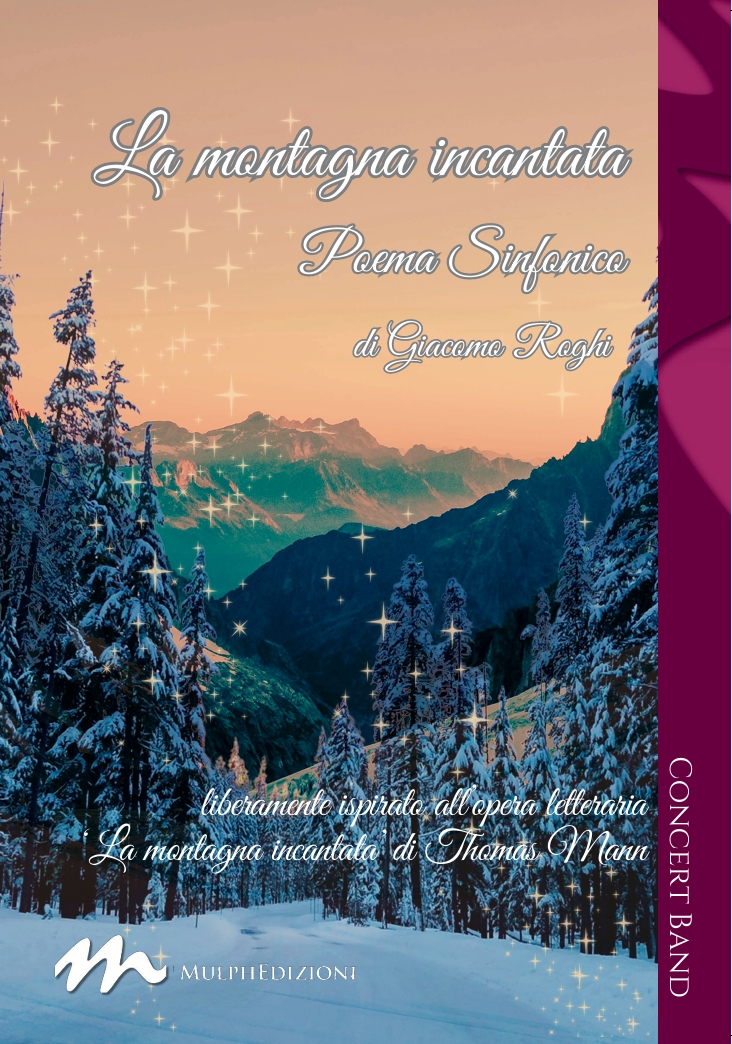
Symphonic Poem freely inspired by Thomas Mann’s literary work “The Magic Mountain”
by Giacomo Roghi
Giacomo Roghi’s opera “The Magic Mountain,” which runs approximately 9.5 minutes, bears the subtitle “A Musical Reflection on the Literary Work of Thomas Mann,” which immediately makes clear to anyone reading the score the composer’s intention to musically reinterpret one of the greatest works in the history of literature: Thomas Mann’s “Der Zauberberg” (translated into Italian as “The Magic Mountain”).
Based on the above, we can therefore classify this work as a symphonic poem for wind orchestra. It contains all the elements that allow us to call it such; in fact, a symphonic poem is defined as “…a composition for orchestra in a single movement, inspired by a non-musical program such as a literary work, a painting, a philosophy, or a legend, musically developing the poetic idea through the expressive resources of the orchestra…”
Essentially, my work is an example of transfiguring a literary work into music, taking its title from it. This work thus falls within the realm of program music, a musical genre that became widespread in the 19th century, initially in Europe and later throughout the world.
Taking inspiration from Wagner’s theater and subsequent operas, I favored the use of leitmotifs, recurring themes that help the listener immediately identify a character, a situation, or an emotional state.
This work can be divided into four parts: the first recounts Hans Castorp’s arrival at the Davos sanatorium and his contracting tuberculosis; the second describes the most characteristic characters Hans Castorp encounters in the sanatorium, in order: his cousin Joachim Ziemsen, Leo Naphta, and Lodovico Settembrini (in this part, Naphta and Settembrini engage in very violent debates that culminate in Naphta’s suicide); the third describes Hans’s falling in love with Madame Chauchat, a love that is not reciprocated; meanwhile, Peeperkorn exerts his charismatic influence on Madame Chauchat and Hans, who is forced to struggle with his feelings; the fourth part revisits the first themes, but in a different light; in fact, it describes the return journey from the Davos sanatorium to Hamburg, Hans’s home city, which he is forced to return from due to the outbreak of the Great War.
Anteprima del PDF


Reviews
There are no reviews yet.