
 Listen
Description
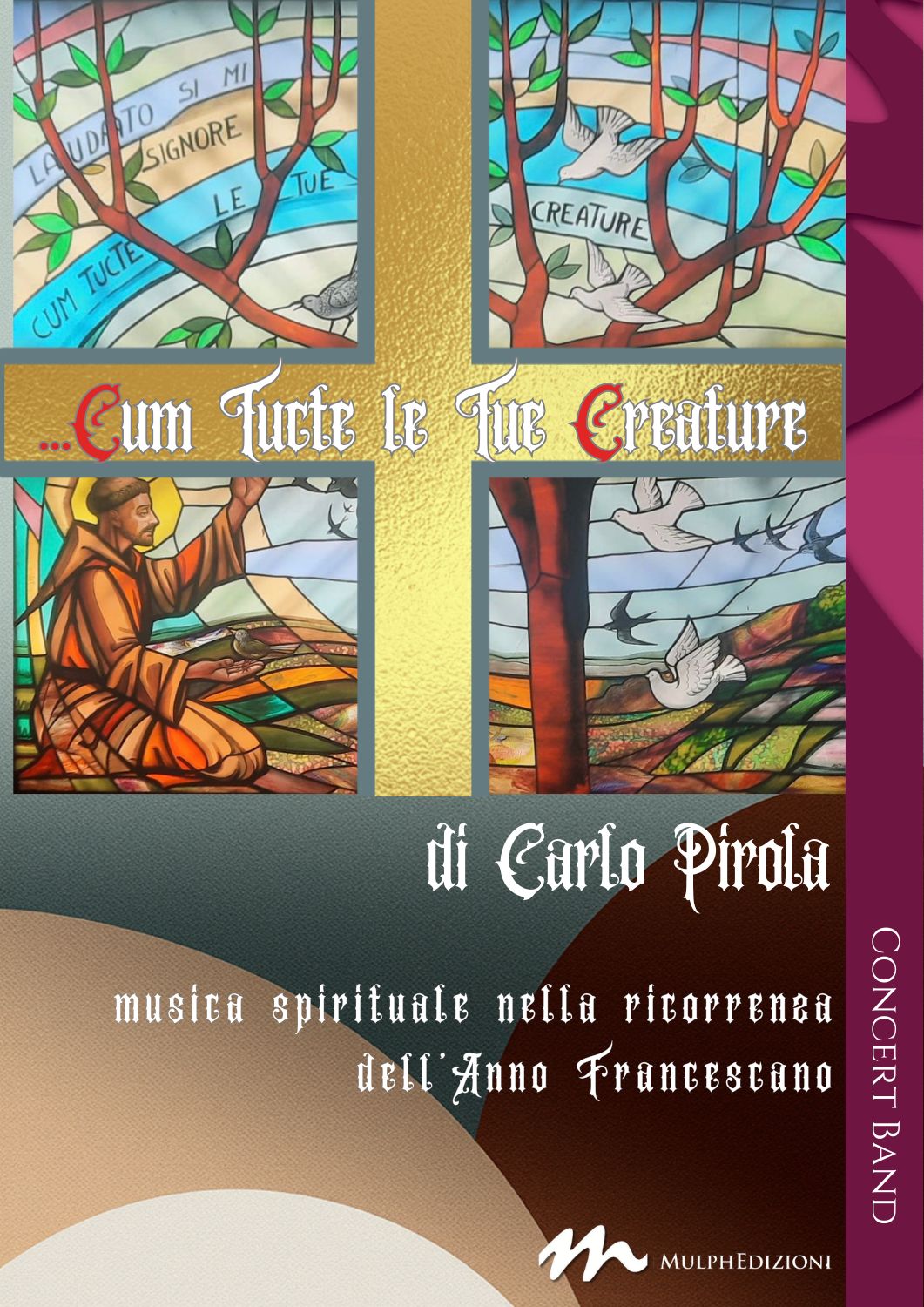
Spiritual Music in the Celebration of the Franciscan Year
by Carlo Pirola
2025 marks the eighth centenary of the Canticle of the Creatures by Saint Francis of Assisi, and 2026 marks the death of this great saint. Francis’s choice to compose this religious text in the vernacular firmly places him as the first author of a poetic text in Italian. The Canticle of the Creatures is the language of Fraternity and Beauty in our relationship with the world.
Here is the Italian translation of the Canticle of the Creatures that I used in my original piece for band, “…CUM TUCTE LE TUE CREATURE,” with the addition of a “narrating voice” accompanied by music and supported by “special” images that I will be sure to illustrate for you to project during the performance.
Altissimo, onnipotente, buon Signore tue sono le lodi, la gloria e l’onore ed ogni benedizione. A te solo, Altissimo, si confanno, e nessun uomo è degno di te.
Laudato sii, o mio Signore, per tutte le creature, specialmente per messer Frate Sole, il quale porta il giorno che ci illumina ed esso è bello e raggiante con grande splendore: di te, Altissimo, porta significazione.
Laudato sii, o mio Signore, per sora Luna e le Stelle: in cielo le hai formate limpide, belle e preziose.
Laudato sii, o mio Signore, per frate Vento e per l’Aria, le Nuvole, il Cielo sereno
ed ogni tempo per il quale alle tue creature dai sostentamento.
Laudato sii, o mio Signore, per sora Acqua, la quale è molto utile, umile, preziosa e casta.
Laudato sii, o mio Signore, per frate Fuoco, con il quale ci illumini la notte:
ed esso è robusto, bello, forte e giocondo.
Laudato sii, o mio Signore, per nostra Madre Terra, la quale ci sostenta e governa
e produce diversi frutti con coloriti fiori ed erba.
Laudato sii, o mio Signore, per quelli che perdonano per amor tuo e sopportano malattia e sofferenza.
Beati quelli che le sopporteranno in pace perchè da te saranno incoronati.
Laudato sii, o mio Signore, per nostra sora Morte corporale,
dalla quale nessun uomo vivente può scampare.
Guai a quelli che morranno nel peccato mortale.
Beati quelli che si troveranno nella tua volontà poichè loro la morte non farà alcun male.
Laudate e benedite il Signore e ringraziatelo e servitelo con grande umiltate
The music follows the text and seeks to set each description of the Canticle with colorful expressiveness, outlining spirituality with specific modern compositional techniques involving melody, harmony, and rhythm, representing the evolution of a renewed world in both religious and social contexts.
The musical themes are thus treated in progressive and continuous variations: initially, there are only four notes exposed in the specific timbres of each section, which then develop, through elaborations and particular dynamics, to form a sound whole that concludes the meaning of each text of “Laudato sii.”
The percussion creates the necessary rhythm to engage new thematic ideas of thanksgiving and praise: a sort of prayer addressed to God, to life, and to nature, which is seen, through the text of the Canticle, in all its beauty and complexity.
And this happens in the final part, with the “sora Morte corporale”, where the music fades and “,,,CUM TUCTE LE TUE CREATURE” leads to calm and serenity, with the final invitation to meditation: an AMEN of due thanks for the service expressed with “great humility” towards “the Most High omnipotent good Lord” performed with the initial thematic cell, in diminuendo, with the entire band.
I thought I’d complement the text of the Canticle of the Creatures with a significant selection of paintings by Vincent van Gogh (1853-1890), a post-Impressionist artist of immense beauty. His bold brushstrokes, choice of colors, setting, nature, landscape, the earth with sun, wind, clouds, water and fire, day and night, work, suffering, death… all references found in St. Francis’s text.
On this spiritual journey, van Gogh seemed like the ideal companion. His paintings are significant, and I conclude with a beautiful quote of his: “The more I think about it, the more I realize that there is nothing more truly artistic than loving others.”
s. – The images of van Gogh’s works are accompanied by the recited text of the Canticle of the Creatures, and during the musical performance of the piece, all interventions are indicated in the score and in a special section for the “narrator.” The material (images and text) is included in the editorial set.
Van Gogh’s works can be replaced with other images or videos relevant to the description of the text of St. Francis’s Canticle of the Creatures.
The historical and human story of Francis becomes a universal symbol of peace, brotherhood, ecological awareness, and dialogue between cultures. Interpreting and spreading this message means promoting a culture of peace and civil responsibility.
The figure of Saint Francis of Assisi has inspired art, literature, and civic and political thought, helping to define a community ethos based on dialogue, reciprocity, and social justice over the centuries.
Carlo Pirola
Anteprima del PDF


Reviews
There are no reviews yet.